
Best for 60fps front video
VIOFO A329S 2CH
4K front (up to 60fps) + 2K rear
90.9
SpecFit Score
Check Price on Amazon

These two dash cams share the same 4K front camera, the same rear camera and the same parking tricks. So the choice really comes down to one trade: the A329T's extra 4x zoom telephoto camera on one side, and the A329S's 60fps front recording and slightly longer storage time on the other. Here we compare the A329S 2CH (front + rear) with the A329T 3CH (front + telephoto + rear).
4K front (up to 60fps) + 2K rear
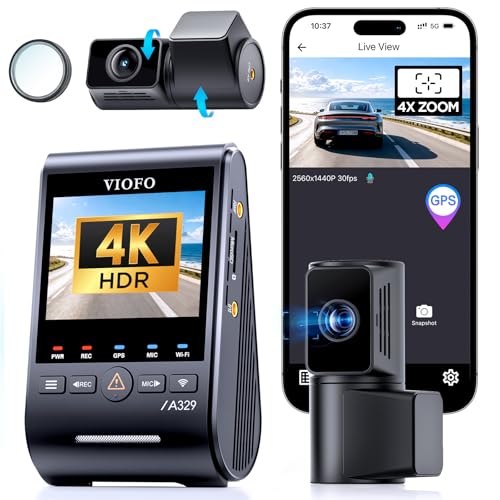
4K front + 2K 4x telephoto + 2K rear
As Amazon Associates, we earn from qualifying purchases. Links on this page may earn us a commission at no extra cost to you. Read more.
The A329T 3CH earns the higher specification-based score, and nearly all of its lead comes from one feature: the 4x optical zoom telephoto camera.
It adds a dedicated forward camera with 4x optical zoom and a narrow 35° view, which is built to pull in license plates and details that sit too far away for a wide 140° lens to show clearly.
Its front camera can record 4K at 60fps (with HDR off), and with one fewer camera writing to storage, VIOFO's own estimates give it roughly 30% more recording days per drive. It is also a simpler two-camera install.
Here is how the two stack up in the areas that matter most for a dash cam, listed from most to least important.
| Decision area | A329S 2CH | A329T 3CH | Edge |
|---|---|---|---|
| Forward recording and plate capture | 4K front, up to 60fps, no zoom camera | 4K front at 30fps plus 2K 4x telephoto | A329T 3CH |
| Rear coverage | 2K HDR, 160° view | 2K HDR, 160° view | Tie |
| Storage and recording time | 512GB microSD, 4TB SSD, about 46 days on 4TB | 512GB microSD, 4TB SSD, about 35 days on 4TB | A329S 2CH |
| Parking surveillance | 5 modes, buffered, low power impact detection | 5 modes, buffered, low power impact detection | Tie |
| Connectivity and everyday use | Wi-Fi 6, GPS, Bluetooth, voice control | Wi-Fi 6, GPS, Bluetooth, voice control | Tie |
| Installation and environment | 2 camera units, -20°C to 65°C | 3 camera units, -20°C to 65°C | A329S 2CH |
The honest way to read this comparison is simple. These are the same camera system wearing different add-ons. Front sensor, rear camera, Wi-Fi, GPS, parking modes, screen, power and temperature range all match. So the score gap is decided by just three differences.
1. The telephoto camera does almost all the work. Forward recording carries the biggest weight (40%) because the front view is where most crash and road incident evidence comes from. Inside that area, long-range detail counts for 35%, and only the A329T has a camera built for it. Its telephoto view is about four times narrower than the main lens, so a distant car takes up far more of the frame. That single difference adds roughly 7.9 points to the A329T's overall score.
2. The A329S claws back a little with 60fps. The A329S 2CH can record its front camera at 4K 60fps, while the A329T 3CH stays at 4K 30fps. Smoother motion can help you freeze a fast moving moment, but 30fps is already the normal standard for dash cams. Also, the A329S drops to 30fps as soon as you turn HDR on. So we treat this as a real but small advantage.
3. Storage time and a simpler install go to the A329S. Three cameras make more video than two, so the same drive fills faster on the A329T. VIOFO's own estimates show about 46 days on a 4TB SSD for the A329S versus about 35 days for the A329T (at three hours of driving a day). Both still hold weeks of footage on a large drive, so this gap matters less than it first looks. The A329S also has one less camera and cable to fit.
Put together, the A329S wins two small categories while the A329T wins the most important one by a wide margin. That is why the A329T comes out ahead, and why its lead holds even when we shuffle the weights.
This is the view that usually settles who caused an accident, so it gets the most weight in our scoring.
| Specification | A329S 2CH | A329T 3CH | Practical meaning |
|---|---|---|---|
| Front sensor | Sony STARVIS 2 IMX678, 8MP, 1/1.8" | Sony STARVIS 2 IMX678, 8MP, 1/1.8" | Identical front camera, so day and night image hardware is the same. |
| Front resolution | 4K (3840 x 2160) | 4K (3840 x 2160) | Same pixel count for the main wide view. |
| Front lens | F1.8, 140° | F1.8, 140° | Same wide view of the road ahead. |
| Max front frame rate | 60fps (HDR off), 30fps with HDR | 30fps | 60fps gives smoother motion and more frames to pause on. It only applies with HDR switched off. |
| Long-range camera | None | 2K telephoto, 4x optical zoom, F2.0, 35° | Optical zoom magnifies with the lens itself, so distant plates get far more real pixels than a crop of the wide view. |
| Telephoto sensor | Not applicable | Sony STARVIS 2 IMX675, 5MP, 1/2.8" | Same low-light sensor family as the rear camera. |
| HDR | Front HDR | Front and telephoto HDR | HDR helps balance bright skies and dark shadows, such as headlights at night. |
The main 4K camera is exactly the same on both. The difference sits around it. A wide 140° lens is great for seeing the whole scene, but anything far ahead becomes small in the frame. The A329T's telephoto camera fills that gap with a narrow 35° view, so you get both the big picture and a zoomed-in look at the car ahead at the same time. The A329S answers with 60fps, which is nice for fast motion but is a smaller practical gain.
Category result: A329T 3CH (97.0 vs 77.3). Substantial advantage.
Rear-end collisions are common, so a sharp rear camera still matters a lot.
| Specification | A329S 2CH | A329T 3CH | Practical meaning |
|---|---|---|---|
| Rear sensor | Sony STARVIS 2 IMX675, 5MP | Sony STARVIS 2 IMX675, 5MP | Same rear camera hardware. |
| Rear resolution | 2K (2560 x 1440) 30fps | 2K (2560 x 1440) 30fps | Same detail behind the car. |
| Rear lens | F1.8, 160° | F1.8, 160° | Same wide view through the back window. |
| Rear HDR | Yes | Yes | Helps when headlights shine straight into the rear lens. |
Nothing separates them here. Both kits ship with the same rotatable 2K rear camera, and both accept the optional CPL-600 filter to cut glare from the rear glass.
Category result: Tie (100 vs 100).
More recording days means less chance that an important clip gets looped over before you save it.
| Specification | A329S 2CH | A329T 3CH | Practical meaning |
|---|---|---|---|
| Max microSD card | 512GB | 512GB | Same card limit. |
| External SSD | Up to 4TB | Up to 4TB | Both can record to a portable SSD for weeks of footage. |
| Estimated days on 512GB card | About 6 days | About 5 days | VIOFO estimate at 3 hours of driving a day, normal bitrate. |
| Estimated days on 4TB SSD | About 46 days | About 35 days | A329S estimate assumes 4K 60fps + 2K. A329T assumes 4K + 2K + 2K, all at 30fps. |
The hardware limits are the same. The A329T simply records one more video stream, so it uses space faster. With a big SSD, both still hold more than a month of normal driving, so we count this as a small edge rather than a deal breaker.
Category result: A329S 2CH (100 vs 94.0). Small advantage.
Parking mode protects your car while you are away, which is when many dings and scrapes happen.
| Specification | A329S 2CH | A329T 3CH | Practical meaning |
|---|---|---|---|
| Parking modes | Hybrid, low power impact, auto event, time-lapse, low bitrate | Hybrid, low power impact, auto event, time-lapse, low bitrate | Same five options. |
| Buffered recording | Yes | Yes | Saves the seconds before an event, not just after it. |
| Low power impact detection | Yes, wakes in about 2 seconds | Yes, wakes in about 2 seconds | Sleeps to save battery and records when bumped. |
| Hardwire kit needed | HK4 or HK6 (sold separately) | HK4 or HK6 (sold separately) | HK6 unlocks hybrid mode and voltage cut-off on both. |
The parking features are identical on paper. One thing VIOFO does not publish is how much power each kit draws while parked, so we cannot say whether the third camera shortens parking time on a battery pack.
Category result: Tie (100 vs 100).
These features decide how easy it is to grab a clip and share it after something happens.
| Specification | A329S 2CH | A329T 3CH | Practical meaning |
|---|---|---|---|
| Wi-Fi | Wi-Fi 6, 2.4GHz and 5GHz | Wi-Fi 6, 2.4GHz and 5GHz | Fast phone downloads on both. |
| GPS | Built in | Built in | Logs speed and location with your video. |
| Bluetooth and voice control | Yes, BTR200 remote optional | Yes, BTR200 remote optional | Lock clips hands-free while driving. |
| Screen and port | 2.4" display, USB-C | 2.4" display, USB-C | Same controls and wired transfer. |
| Multiplex video | Yes | Yes | Combines views into one split-screen file, which on the A329T can include the telephoto view. |
Category result: Tie (100 vs 100).
A neat install and a wide temperature range keep the camera working day after day.
| Specification | A329S 2CH | A329T 3CH | Practical meaning |
|---|---|---|---|
| Camera units | 2 (front, rear) | 3 (front, telephoto, rear) | One more unit on the windshield and one more short cable to route. |
| Operating temperature | -20°C to 65°C | -20°C to 65°C | Same range on both. |
| Power | Supercapacitor, DC 5V/2A | Supercapacitor, DC 5V/2A | No lithium battery inside, which copes better with heat. |
| Telephoto and rear unit size | Rear: 2.79 x 1.2 x 1.61 in | Each: 2.79 x 1.2 x 1.61 in | The telephoto unit is the same small barrel shape as the rear camera. |
The telephoto camera sits on the windshield close to the main unit, and VIOFO offers short cable options for it. Still, it is one more thing to mount and aim, so the A329S gets a small edge here.
Category result: A329S 2CH (100 vs 88.0). Small advantage.
We tested ten scenarios, raising and lowering each major area's weight by 20%. The A329T 3CH stayed ahead in all ten. That is partly because most areas are a tie, so changing their weight barely moves the gap.
Move the sliders to match what matters to you. The weights rebalance to 100% automatically. This only changes how much each area counts. The underlying specifications stay exactly the same, and nothing you choose is saved or sent anywhere.
| Scoring factor | Weight |
|---|---|
| Forward recording and plate capture | 40% |
| Rear coverage | 15% |
| Storage and recording time | 15% |
| Parking surveillance | 15% |
| Connectivity and everyday use | 10% |
| Installation and environment | 5% |
| Total | 100% |
The scores use only verified, relevant specifications, weighted for what usually matters most when picking a dash cam. We look at how useful each difference is in real driving, not how many table rows each camera wins, and we allow for diminishing returns, which is why 60fps counts for less than the telephoto camera. Every scored item was confirmed for both cameras, so no figures needed adjusting for missing data. The number is a decision aid, not a guarantee of video quality, reliability or how either camera will perform in your car. Read more here.
A spec sheet cannot prove how readable a plate will actually be at a given distance, speed or light level. That depends on your windshield, mounting angle, weather and firmware, so the telephoto's real advantage will vary from car to car. The storage figures are VIOFO's own estimates, and long-term reliability, app experience and parking power draw are not covered by the published specifications either.