
Rove R2-4K
1 channel · 5MP Sony STARVIS IMX335 · Wi-Fi 6
48.9
SpecFit Score out of 100
Check Price on Amazon

Here we put the single-camera Rove R2-4K (the current USB-C, Wi-Fi 6 version) up against the two-camera VIOFO A229 Pro 2CH, and look at what really decides a dash cam: how much real detail it records, how much of the car it covers, how well it guards a parked car, and the everyday stuff that makes it easy to live with.
1 channel · 5MP Sony STARVIS IMX335 · Wi-Fi 6
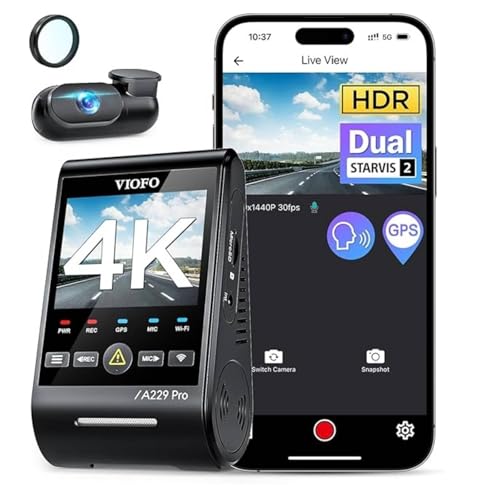
2CH · 8MP STARVIS 2 front + 5MP STARVIS 2 rear
As Amazon Associates, we earn from qualifying purchases. Links on this page may earn us a commission at no extra cost to you. Read more.
The VIOFO records a true 4K picture from a sensor that actually has enough pixels for it, it adds a second camera for the back of the car, and it gives you proper buffered parking mode. The Rove is a tidy single-camera unit with a couple of nice touches, but on paper it simply covers less and captures less.
It records the road ahead and the road behind, and its front 4K comes from an 8MP sensor. Rove's 4K mode is built from a 5MP sensor, so some of that resolution has to be filled in.
You only want one small camera up front, and you like that it ships with both a suction mount and an adhesive mount, a slightly wider 150° view and an F1.5 lens.
| Decision area | Rove R2-4K | VIOFO A229 Pro | Edge |
|---|---|---|---|
| Front video capture | 4K output from a 5MP sensor, WDR | Native 4K from an 8MP STARVIS 2 sensor, HDR | VIOFO A229 Pro |
| Camera coverage | Front only | Front plus 2K rear, can add a cabin camera | VIOFO A229 Pro |
| Parking protection | Impact-triggered recording | Buffered motion events, time-lapse, low bitrate | VIOFO A229 Pro |
| Connectivity and GPS | Wi-Fi 6, built-in GPS | Dual-band Wi-Fi, quad-mode GPS, USB-C to phone | VIOFO A229 Pro (small) |
| Durability hardware and warranty | Supercapacitor, 12-month warranty | Supercapacitor, 18-month warranty | VIOFO A229 Pro |
| Everyday convenience | Voice alerts, two mount types | Voice commands, front CPL included | VIOFO A229 Pro |
The gap isn't about winning lots of little rows. It comes from three things that matter a lot when you actually need footage.
Bars show points out of each area's maximum on a common 35-point scale.
The Rove's own wins, like its wider lens and faster aperture, are real but small. They nudge its front-video score up a little, but they can't make up for a missing rear camera.
This is the camera that sees most crashes coming, so how much true detail it captures matters more than anything else.
| Specification | Rove R2-4K | VIOFO A229 Pro | Practical meaning |
|---|---|---|---|
| Image sensor | Sony STARVIS IMX335, 5MP, 1/2.8" | Sony STARVIS 2 IMX678, 8MP, 1/1.8" | More real pixels means more genuine detail to work with, like plates and signs. |
| Max front recording | 3840 × 2160 at 30fps, or 2560 × 1440 at 30fps | 3840 × 2160 at 30fps | Same label on the box, but only the VIOFO sensor natively fills a 4K frame. |
| Lens aperture | F1.5 | F1.8 | A wider aperture lets in more light. Rove has a small edge here. |
| Low-light tech | STARVIS, "Super Night Vision" | STARVIS 2, Super Night Vision | STARVIS 2 is Sony's newer generation with wider dynamic range. Overall close, slight VIOFO edge. |
| Bright and dark scenes | WDR | HDR on front and rear | HDR helps keep headlights, plates and shadows readable in the same shot. |
| Field of view | 150° | 140° | Both cover a normal road width well. Wider also spreads pixels thinner. |
Here's the key bit. A 4K frame needs about 8.3 million pixels, and the Rove's sensor has about 5 million, so its 4K mode has to stretch the image. That doesn't make the Rove bad, it just means its real ceiling is closer to 2K. The VIOFO earns its 4K label honestly.
Edge: VIOFO A229 Pro (68.1 vs 90.9 in this area)
A dash cam can only record what it can see, so the number of angles it covers is a big deal.
| Specification | Rove R2-4K | VIOFO A229 Pro | Practical meaning |
|---|---|---|---|
| Cameras in the box | 1 (front) | 2 (front and rear) | Rear coverage records tailgaters and rear-end impacts. |
| Rear camera | None | 2560 × 1440 at 30fps, STARVIS 2 IMX675, F1.9, 160° | A 2K rear camera is sharper than the 1080p rear units many dual cams use. |
| Room to grow | No extra camera input listed | Can take an optional cabin camera | Useful for rideshare drivers who want an interior view later. |
This one is simple. If something happens behind you, the VIOFO has a recording and the Rove doesn't.
Edge: VIOFO A229 Pro (0 vs 100 in this area)
Lots of damage happens when nobody is in the car, like dings in a car park or a hit-and-run overnight.
| Specification | Rove R2-4K | VIOFO A229 Pro | Practical meaning |
|---|---|---|---|
| Parking modes | 24-hour auto-trigger on impact | Auto event detection, time-lapse, low bitrate | More modes let you balance coverage, storage and car battery use. |
| Buffered recording | Not documented (records after impact) | Yes, 15 seconds before and 30 seconds after an event | Buffering catches what led up to the incident, not just what came after. |
| Hardwire kit needed | Yes, sold separately | Yes, sold separately | Both need a hardwire kit before any parking mode works. |
Both cameras need a little extra wiring, so that part's a tie. Once wired, the VIOFO simply gives you more ways to watch your car, and its buffered event mode is the one that tends to save the useful seconds.
Edge: VIOFO A229 Pro (40 vs 95 in this area)
This is about how easily you get clips onto your phone and how well your speed and location are logged.
| Specification | Rove R2-4K | VIOFO A229 Pro | Practical meaning |
|---|---|---|---|
| Wi-Fi | Wi-Fi 6, up to 6MB/s claimed (needs a Wi-Fi 6 phone) | Dual-band 2.4GHz and 5GHz | Both are a big step up from old 2.4GHz-only cams. Treat as a tie. |
| Wired transfer | USB-C data cable to PC or Mac; direct-to-phone not documented | USB-C to phone, up to 20MB/s claimed on iPhone 16 | Handy for pulling big 4K files fast. Rove's phone support is unknown, so this row isn't scored. |
| GPS | Built-in GPS | Built-in quad-mode (GPS, BeiDou, Galileo, GLONASS) | More satellite systems usually means faster, steadier location fixes. |
| Max microSD | 512GB | 512GB | Same storage ceiling. |
Edge: VIOFO A229 Pro, small (83.1 vs 86.9 in this area)
A dash cam lives on a hot windshield, so heat tolerance and power design really count.
| Specification | Rove R2-4K | VIOFO A229 Pro | Practical meaning |
|---|---|---|---|
| Power storage | Supercapacitor | Supercapacitor | Both avoid lithium batteries, which can swell in heat. |
| Operating temperature | -20°C to 60°C | -20°C to 65°C | Five extra degrees helps on very hot dashboards. |
| Warranty | 12 months | 18 months | Six more months of cover from VIOFO. |
Edge: VIOFO A229 Pro (79.5 vs 90.5 in this area)
Small things, but you'll notice them every day.
| Specification | Rove R2-4K | VIOFO A229 Pro | Practical meaning |
|---|---|---|---|
| Voice features | Voice guidance and alerts | Voice commands plus voice notifications | Saying "lock video" beats reaching for a button while driving. |
| Anti-glare CPL filter | Optional extra | Front CPL included | A CPL cuts dashboard reflections on the windshield. |
| Mounts in the box | Suction mount and adhesive mount | Adhesive mount | Rove's suction mount makes moving it between cars easy. |
| Screen | 2.4" IPS | 2.4" | Same size, not scored. |
Edge: VIOFO A229 Pro (57 vs 89 in this area)
Not much, honestly. We nudged each major area's importance up and down by 20 percent, and the VIOFO stayed ahead in all 10 tests.
Even if you ignore the rear camera completely and only judge the front unit, the VIOFO still leads by about 91 to 65. The Rove's genuine strengths, like its suction mount and wider lens, are things the specs can't turn into a big enough advantage to flip the result.
Move the sliders to match what matters to you. This only changes how much each area counts. It doesn't change any product specs, and nothing you pick is saved or sent anywhere.
| Scoring factor | Weight |
|---|---|
| Front video capture | 35% |
| Camera coverage | 25% |
| Parking protection | 15% |
| Connectivity and GPS | 10% |
| Durability hardware and warranty | 10% |
| Everyday convenience | 5% |
| Total | 100% |
The scores only use verified, relevant specs, weighted by how much they matter when choosing a dash cam. What a spec does for you counts more than how many rows a product wins, and we taper the credit once a spec is already good enough. One small item, direct phone transfer on the Rove, couldn't be confirmed, so it was left out of both scores, which is why coverage sits at 98%. The number is a decision aid, not a promise about video quality or how long either camera will last. Read more here.
Specs can tell you about sensors and pixels, but not exactly how readable a plate will be at night or how each brand's image processing looks in your car. They also say nothing about long-term reliability or how helpful support is when something goes wrong. One more thing: the Rove R2-4K name has covered older hardware too, so we scored the current USB-C, Wi-Fi 6 version described by Rove. Check that the unit you get matches it.