
VIOFO A329S 2CH
4K front + 2K rear, Sony STARVIS 2
Specification-based winner SpecFit Score91.3/100
Check Price on Amazon

A comparison of the two-channel front and rear versions, focusing on 4K recording options, parking coverage, video storage, transfers and the shared hardware that matters for everyday driving.
4K front + 2K rear, Sony STARVIS 2
Specification-based winner SpecFit Score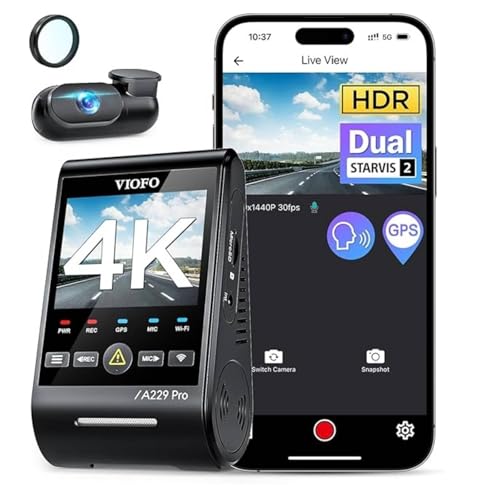
4K front + 2K rear, Sony STARVIS 2
Strong core recording features SpecFit ScoreAs Amazon Associates, we earn from qualifying purchases. Links on this page may earn us a commission at no extra cost to you. Read more.
The A329S scores higher chiefly because it offers a 4K 60fps recording mode, two additional parking modes, external SSD support and Wi-Fi 6. These are real capabilities, but its 60fps front mode turns HDR off. In 4K 30fps HDR recording, both models have the same front and rear Sony sensor models and resolutions.
Common Verified Coverage: 100% of the scoring model. Ranking Stability: 100% across eight tested 20% relative weight adjustments. These are methodology measures, not guarantees of real-world results.
Choose the A229 Pro when you need conventional 4K HDR front and 2K HDR rear recording, buffered parking detection, GPS and voice control, but do not need the A329S-specific extras. Specifications alone cannot establish a meaningful image-quality difference between the two in their shared HDR recording mode.
| Decision area | A329S 2CH | A229 Pro 2CH | Edge |
|---|---|---|---|
| Front recording | 4K 60fps with HDR off, or 4K 30fps HDR | 4K 30fps HDR | A329S for 60fps flexibility |
| Front and rear imaging hardware | IMX678 front; IMX675 rear | IMX678 front; IMX675 rear | Tie on verified sensors |
| Parking features | Three shared modes plus low-power impact and hybrid | Three conventional modes | A329S |
| Storage options | Up to 512GB microSD or up to 4TB external SSD | Up to 512GB microSD | A329S |
| Wireless transfer | Dual-band Wi-Fi 6 | Dual-band Wi-Fi 5 | A329S |
| Core controls | GPS, voice commands, 2.4-inch screen, USB-C | GPS, voice commands, 2.4-inch screen, USB-C | Tie on documented functions |
Parking flexibility is the biggest contributor. The A329S adds low-power impact detection and hybrid parking to the buffered event, time-lapse and low-bitrate choices already supported by the A229 Pro. Those extra modes matter most when the camera must monitor a parked car under different power conditions.
Storage and file access also matter. External SSD support provides an optional larger recording medium, while Wi-Fi 6 gives the A329S a more capable wireless connection for retrieving footage. Neither feature independently proves longer reliable operation or faster transfers in every vehicle and phone setup.
Its recording advantage is specific rather than universal. The A329S can record 4K at 60fps on the front camera, but only with front HDR disabled. If HDR at 4K 30fps is your preferred mode, the verified headline recording specifications are much closer.
Front and rear capture matter most for a dash cam. Frame rate can affect motion detail, while HDR helps manage bright and dark parts of a scene. Neither specification alone proves readable plates in every condition.
| Specification | A329S 2CH | A229 Pro 2CH | Practical meaning |
|---|---|---|---|
| Front sensor | Sony STARVIS 2 IMX678, 8MP | Sony STARVIS 2 IMX678, 8MP | Same listed sensor model; no sensor-model win. |
| Rear sensor | Sony STARVIS 2 IMX675, 5MP | Sony STARVIS 2 IMX675, 5MP | Same listed rear sensor model. |
| Front, higher frame-rate option | 3840 × 2160 at 60fps, HDR off | No listed 4K 60fps mode | More frequent frames can help examine motion, with an HDR trade-off. |
| Front with HDR | 3840 × 2160 at 30fps | 3840 × 2160 at 30fps | Equivalent listed front HDR resolution and frame rate. |
| Rear recording | 2560 × 1440 at 30fps, HDR | 2560 × 1440 at 30fps, HDR | Equivalent listed rear recording format. |
| Field of view | Front 140°; rear 160° | Front 140°; rear 160° | Same declared coverage angles. |
| Lens aperture | Front f/1.8; rear f/1.8 | Front f/1.8; rear f/1.9 | Small rear lens difference; not scored as video quality. |
Category edge: A329S, conditional on wanting 60fps. For 4K HDR driving footage, the documented recording modes are effectively tied. Real-world tests would be needed to rank clarity, exposure and plate readability.
Parking modes affect what the camera records while the vehicle is off. They require an appropriate continuous power installation, and the selected mode changes the balance between coverage and power use.
| Specification | A329S 2CH | A229 Pro 2CH | Practical meaning |
|---|---|---|---|
| Buffered auto event detection | Supported | Supported | Both can retain a buffered interval around detected events. |
| Time-lapse parking | Supported | Supported | Both provide a lower-frame-rate parked recording option. |
| Low-bitrate recording | Supported | Supported | Both can record smaller continuous files. |
| Low-power impact detection | Supported | Not offered in the A229 Pro's documented modes | An additional low-power monitoring option on the A329S. |
| Hybrid parking mode | Supported with suitable HK6 setup | Not offered in the A229 Pro's documented modes | On the A329S, a switch between conventional parking capture and low-power impact mode. |
| Hardwire requirement | Required for unattended parking; HK4/HK6 supported | Required for unattended parking; HK4 listed, HK6 accessory compatibility documented | A suitable kit and vehicle installation are separate from the two-camera package. |
Category edge: A329S. Its advanced modes are useful options, not proof that ordinary buffered parking on the A229 Pro fails. The A329S's hybrid features require compatible wiring, and low-power wake recordings need an inserted microSD card even when an SSD is attached.
Supported media determines the storage setups available for video files. Total recording duration still depends on encoding settings, bitrate, the number of cameras and the chosen recording mode.
| Specification | A329S 2CH | A229 Pro 2CH | Practical meaning |
|---|---|---|---|
| Maximum supported microSD | 512GB | 512GB | Equal documented removable-card capacity. |
| External SSD recording | Supported up to 4TB | Not listed as a supported recording medium | A329S supports a separate, higher-capacity media option. |
| Use without external SSD | microSD recording supported | microSD recording supported | Neither requires an SSD for normal driving. |
| Low-power wake recording medium | microSD required for the new low-power modes | Not applicable to its listed parking modes | The A329S's special parking features cannot rely solely on an SSD. |
Category edge: A329S for storage flexibility. The shared 512GB microSD limit already satisfies many ordinary recording setups. The external SSD option receives limited additional scoring credit rather than being treated as an eightfold improvement in useful quality or duration.
A fast connection is valuable when you need to copy a large 4K recording to a phone. Connection standards identify supported capabilities, not a guaranteed download speed in every setting.
| Specification | A329S 2CH | A229 Pro 2CH | Practical meaning |
|---|---|---|---|
| Wi-Fi standard | Wi-Fi 6 | Wi-Fi 5 | Newer wireless capability on the A329S; speeds vary by device and conditions. |
| Wi-Fi frequencies | 2.4GHz and 5GHz | 2.4GHz and 5GHz | Both support common dual-band connections. |
| USB data connector | USB Type-C | USB Type-C | Same physical connector family, not evidence of equal transfer speeds. |
| Wireless remote option | Bluetooth, optional BTR200 | Bluetooth, optional BTR200 | Shared documented remote-control compatibility. |
Category edge: A329S. Wi-Fi 6 provides a more capable connection standard, but it does not turn a 4K file into a smaller file or guarantee a particular measured download time.
These details help confirm suitability for a vehicle, but small dimensional and lens differences are not reliable indicators of better day-to-day performance.
| Specification | A329S 2CH | A229 Pro 2CH | Practical meaning |
|---|---|---|---|
| Cameras in compared package | Front and rear | Front and rear | Neither listed ASIN is the three-camera cabin package. |
| GPS logger | Built in | Built in | Both can record location information. |
| Voice control and notifications | Supported | Supported | Both support hands-free commands and status notices. |
| Screen | 2.4-inch LCD | 2.4-inch LCD | Equal stated display size. |
| Power reserve | Supercapacitor, no battery | Supercapacitor, no battery | Both require vehicle power for ongoing recording. |
| Operating temperature range | −20°C to 65°C | −20°C to 65°C | Equal official specified range. |
| Front unit dimensions | 2.4 × 3.9 × 1.7 in | 2.3 × 3.9 × 1.8 in | Minor shape difference; check windshield clearance. |
| Front CPL filter | Included | Included | Both include a front windshield reflection filter. |
Category result: effectively tied. Each covers the everyday essentials of a two-channel front and rear dash cam. The different rear camera cables are not interchangeable if you are moving from an A229 Pro to an A329S.
The A329S remains ahead in all eight tested scenarios that increase or decrease each major dimension's weight by 20% relative to its baseline. However, buyers who do not use 60fps, external SSDs or the new parking modes may see little practical difference. Direct, comparable video tests, actual storage retention data or a required installation constraint could matter more than this feature-based result.
Change the relative importance of each category to see new scores using the same documented feature assessments. The weights are automatically normalized to 100%. These adjustments reflect your preferences and do not change the hardware specifications.
Updated scores use normalized weights. The baseline summary above remains the site's general-use recommendation.
The baseline model uses five decision areas in order of importance for a front and rear dash cam. We scored verified shared capabilities conservatively and gave limited extra credit for 60fps, newer parking features, external SSD support and Wi-Fi 6. The table shows baseline weights before any reader adjustments.
| Scoring factor | Weight |
|---|---|
| Recording capability | 40% |
| Parking coverage | 25% |
| Storage options | 15% |
| File access | 15% |
| Core operation | 5% |
| Total | 100% |
Each dimension combines its relevant criteria with internal utility scores, rather than counting table rows. Shared 4K HDR capture and 512GB microSD support receive equal credit; optional improvements receive less credit once the ordinary task is already well covered. The resulting number is a specification-based decision aid, not a measured percentage of image quality, reliability or product performance.
Equal Sony sensor models do not guarantee equal footage, and higher frame rates do not guarantee identifiable number plates. This comparison does not establish actual low-light detail, thermal stability, long-term reliability, microphone quality, application ease of use or real-world parking battery drain. The manufacturer's 60fps front mode uses HDR off, so the claimed frame-rate advantage must be weighed against your preference for HDR. Vehicle wiring, rear cable routing and storage media selection also affect the final setup.